Bladder · Treatment
Robot-assisted radical cystectomy
Completely intracorporeal. The most demanding operation in robot-assisted urology.
Technique
Intracorporeal
removal and urinary diversion entirely inside the body
Function
Nerve-sparing
in men and women, as far as oncologically justifiable
Oncology
Lymph node dissection
practically always part of the operation
The operation
The bladder is removed together with the neighbouring organs the tumour can reach.
The pelvic lymph nodes are removed as well and examined histologically.
The new urinary diversion is created in the same operation.
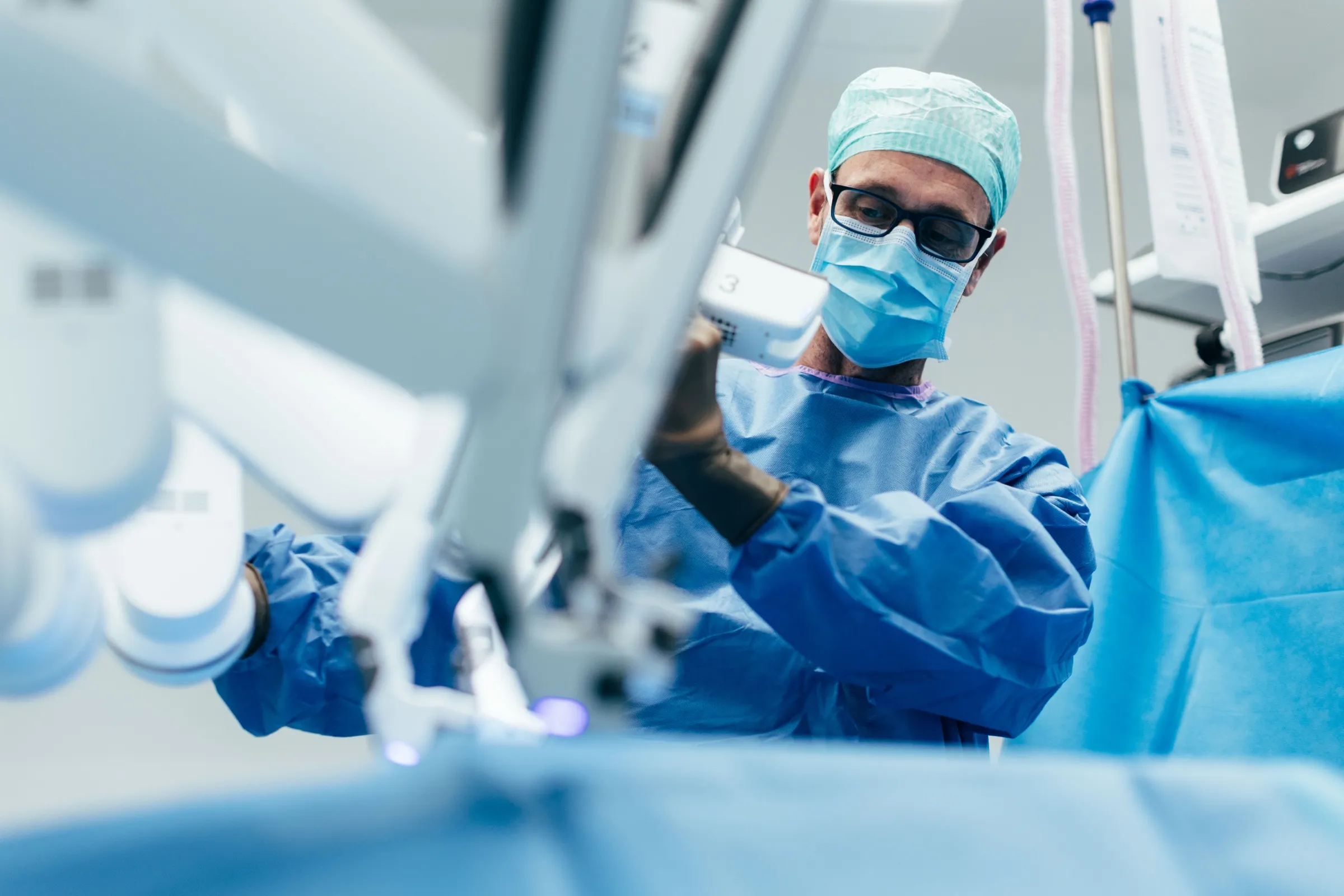
All steps are performed robot-assisted through a few small ports.
The difference
Completely intracorporeal
The new urinary diversion, too, is created entirely inside the body — not through an additional abdominal incision.
What that means
The urinary diversion can be reconstructed outside the body — through an additional incision in the abdominal wall. Intracorporeal means: this step is omitted. The bowel stays where it is and is reshaped inside the abdomen.
Why it is demanding
The completely intracorporeal cystectomy is considered the most technically demanding procedure in robot-assisted urology. It requires experience in both tumour surgery and reconstruction.
In randomised trials, the robot-assisted approach is oncologically equivalent to open surgery, with less blood loss, fewer transfusions and faster recovery.
Why this is technically demanding
Removing is one part. Rebuilding is the other.
After the bladder has been removed, a new path for the urine has to be built from a segment of small bowel — sutured, watertight and connected to the ureters. It is exactly this reconstruction that we perform entirely inside the body.
This requires suturing in hard-to-reach places over hours — it is the most technically demanding part of the procedure.
Nerve-sparing
Fine nerves run around the bladder that are needed for sexual function and continence. Where the tumour allows it, they are spared — in men and women alike.
It is always the findings that draw the line. Nerve-sparing does not come at the expense of safety: where the tumour reaches the nerve pathways, complete removal takes priority. What is possible in your case, we discuss openly with you before the operation.
Lymph nodes
The pelvic lymph nodes are practically always part of the operation. They filter tissue fluid and can take up tumour cells that have left the bladder. Their histological examination shows whether the tumour has spread — and is thus both treatment and the most important information for everything that follows.
Second opinion
Cystectomy recommended? We review your findings in our second-opinion consultation.
Sources
Parekh DJ, Reis IM, Castle EP, et al. Robot-assisted radical cystectomy versus open radical cystectomy in patients with bladder cancer (RAZOR): an open-label, randomised, phase 3, non-inferiority trial. Lancet 2018.
Catto JWF, Khetrapal P, Ricciardi F, et al. Effect of robot-assisted radical cystectomy with intracorporeal urinary diversion vs open radical cystectomy on 90-day morbidity and mortality among patients with bladder cancer. JAMA 2022.
Mastroianni R, Tuderti G, et al. Robot-assisted radical cystectomy with totally intracorporeal urinary diversion versus open radical cystectomy: 3-year outcomes from a randomised controlled trial.
Treatment of Non-Metastatic Muscle-Invasive Bladder Cancer: AUA/ASCO/SUO Guideline.
Contact
Second opinion on bladder cancer
Before a cystectomy, a second look is worthwhile. Bring your reports, imaging and the TURBT report.
Consultation hours
- Wednesday · 14:00
- Thursday · 08:30–16:00
PD Dr. med. Sami-Ramzi Leyh-Bannurah. Appointments are arranged by the urology secretariat.