Prostate · Treatment
Robot-assisted radical prostatectomy
Remove the tumour completely. And preserve as much function as possible.
Access
Minimally invasive
a few ports of about one centimetre
Vision
3D stereo endoscope
two-channel HD, 1080p per eye · about 10× magnification compared with the naked eye
Control
Frozen section
surgical margins examined while the operation is under way
At a glance
The prostate is removed together with the seminal vesicles; bladder and urethra are then rejoined.
The frozen section answers, while the operation is still under way, how much nerve tissue can stay.
As much nerve preservation as is oncologically justifiable.
Lymph node dissection where the risk is raised.
The operation
The surgeon controls the instruments from a console. The operative field appears in three dimensions at up to ten times magnification; the instruments follow the hand across several axes of movement. That allows dissection along the finest nerve structures.
The prostate and the seminal vesicles are removed. Bladder and urethra are then joined together again.
Preserving function
The most important decision is made during the operation
How much nerve tissue can be preserved without leaving tumour behind? That question is answered on the tissue itself — while the operation is still under way.
Frozen section following the NeuroSAFE principle
The surgical margins at the neurovascular bundle are examined histologically while the operation is still under way. Margin clear of tumour — the nerve tissue stays. Tumour at the margin — the area is precisely re-resected.
Sleeve technique
Preservation of the structures beside and in front of the prostate. Co-described in the standard reference Robotic Urology (Springer, 2024).
Lymph node dissection by risk
Where the risk is raised, the pelvic lymph nodes are removed in an extended or superextended dissection.
The robot does not operate
It transmits. Every movement of the hand is passed on to the instruments precisely and freed of tremor — and the instrument tips are more mobile than a human wrist. Nothing happens automatically; with no hand on the controls, nothing moves.
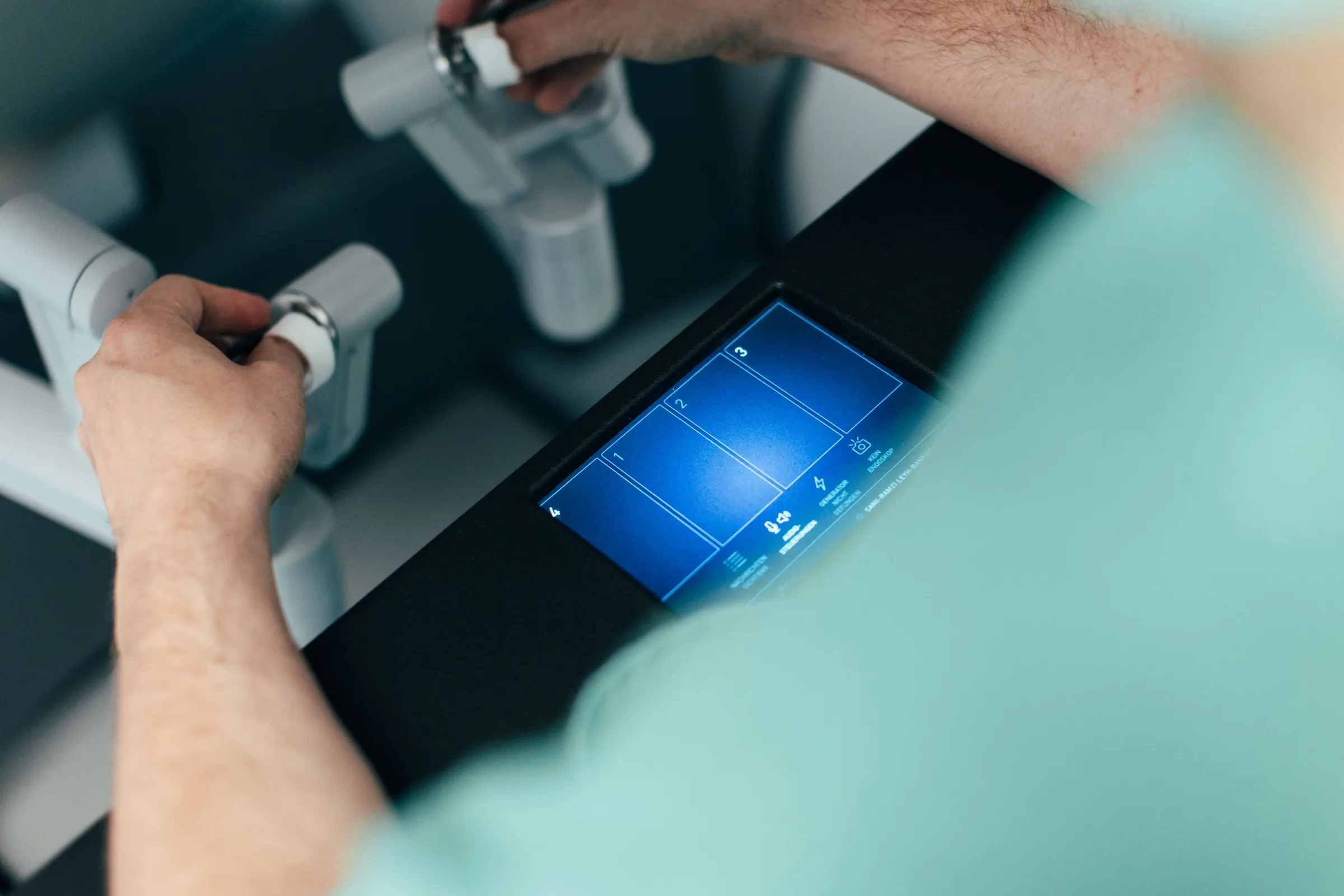
The console's control grips: thumb and index finger guide the instruments, the foot pedals control camera and energy.
Second opinion
Received a diagnosis? We will go through your findings with you in the second-opinion clinic.
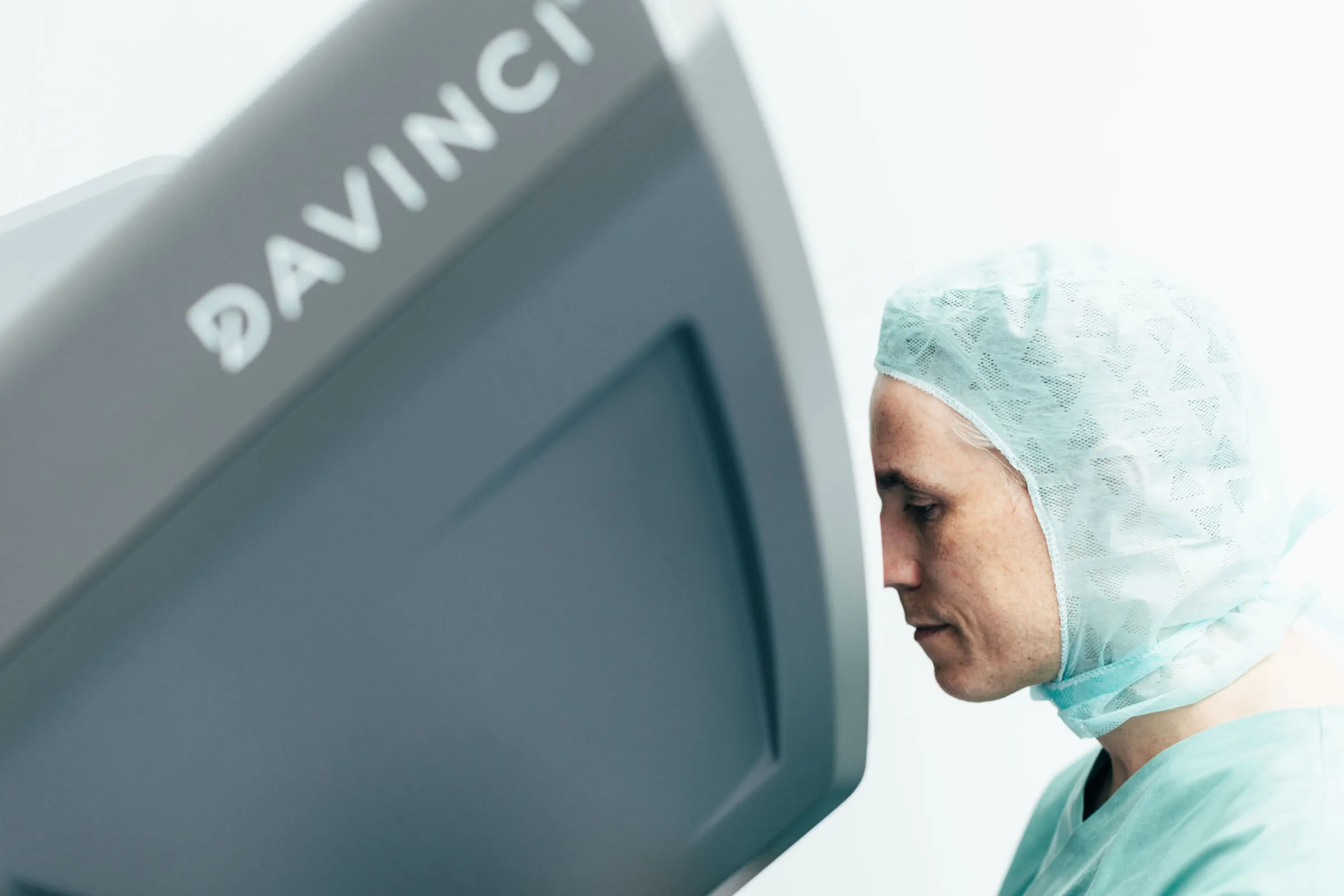
In theatre
The head of the section performs your operation himself
At the console sits no assistant and no changing team, but the surgeon who advised you in the consultation and who sees you again at follow-up. The robot does not operate by itself — it transmits every movement of the hand, precisely and free of tremor.
Who reads the frozen section
Half the value of the method rests with the pathology.
The specimens are read by MVZ für Pathologie Hamm — two board-certified pathologists, both with more than 20 years of experience. The practice sits at the same address as the hospital: the specimen never leaves the grounds. Short distances are not a convenience here; they are the condition for the frozen section being able to steer the operation at all.
Pathology — cooperation partner
MVZ für Pathologie Hamm
- Dr. med. Michaela Grosse-Holz
- Dr. med. Kurt Diebold
Continence and potency
Two questions matter to almost every patient. So they come first.
“Will I be dry again?”
85–93%
of patients in large studies from experienced centres are continent again one year after the operation — no pad, or at most one pad per day.
With advanced tumours it more often takes longer at first; between the third and the twelfth month the results largely converge.
“Will erections still be possible?”
56–62%
regain an erection sufficient for intercourse one year after bilateral nerve-sparing surgery — depending on age and baseline function.
With the intraoperative frozen section this share rises to around 68%, because nerve-sparing surgery becomes possible far more often.
Ficarra V, Novara G, Rosen RC, et al. Systematic review and meta-analysis of studies reporting urinary continence recovery after robot-assisted radical prostatectomy. Eur Urol 2012;62(3):405–417 — and Ficarra V, Novara G, Ahlering TE, et al. Systematic review and meta-analysis of studies reporting potency rates after robot-assisted radical prostatectomy. Eur Urol 2012;62(3):418–430. The share of around 68% comes from NeuroSAFE PROOF (Lancet Oncol 2025). These figures come from large published studies; your personal result depends on tumour stage, age and baseline function.
What the frozen section changes
97%
instead of 81%
share of operations performed nerve-sparing with the intraoperative frozen section.
15%
instead of 22%
share of positive surgical margins with the intraoperative frozen section.
Figures from the randomised NeuroSAFE PROOF trial: Dinneen E, Almeida-Magana R, Al-Hammouri T, et al. Effect of NeuroSAFE-guided RARP versus standard RARP on erectile function and urinary continence. Lancet Oncol 2025. — These results come from published studies. Your personal result depends on tumour stage, age and baseline function; we discuss this with you individually.
Why experience counts
Experience can be measured. Published learning curves show the number of operations beyond which results no longer improve appreciably: surgical margins from roughly 200 to 250 procedures, potency results from roughly 600 to 700, continence results from roughly 700 to 800. Your surgeon is above all of these thresholds.
Added to this is experience with difficult starting situations: a substantial share of the prostate cancers operated on was locally advanced.
Vickers AJ, Bianco FJ, Serio AM, et al. The surgical learning curve for prostate cancer control after radical prostatectomy. J Natl Cancer Inst 2007;99(15):1171–1177.
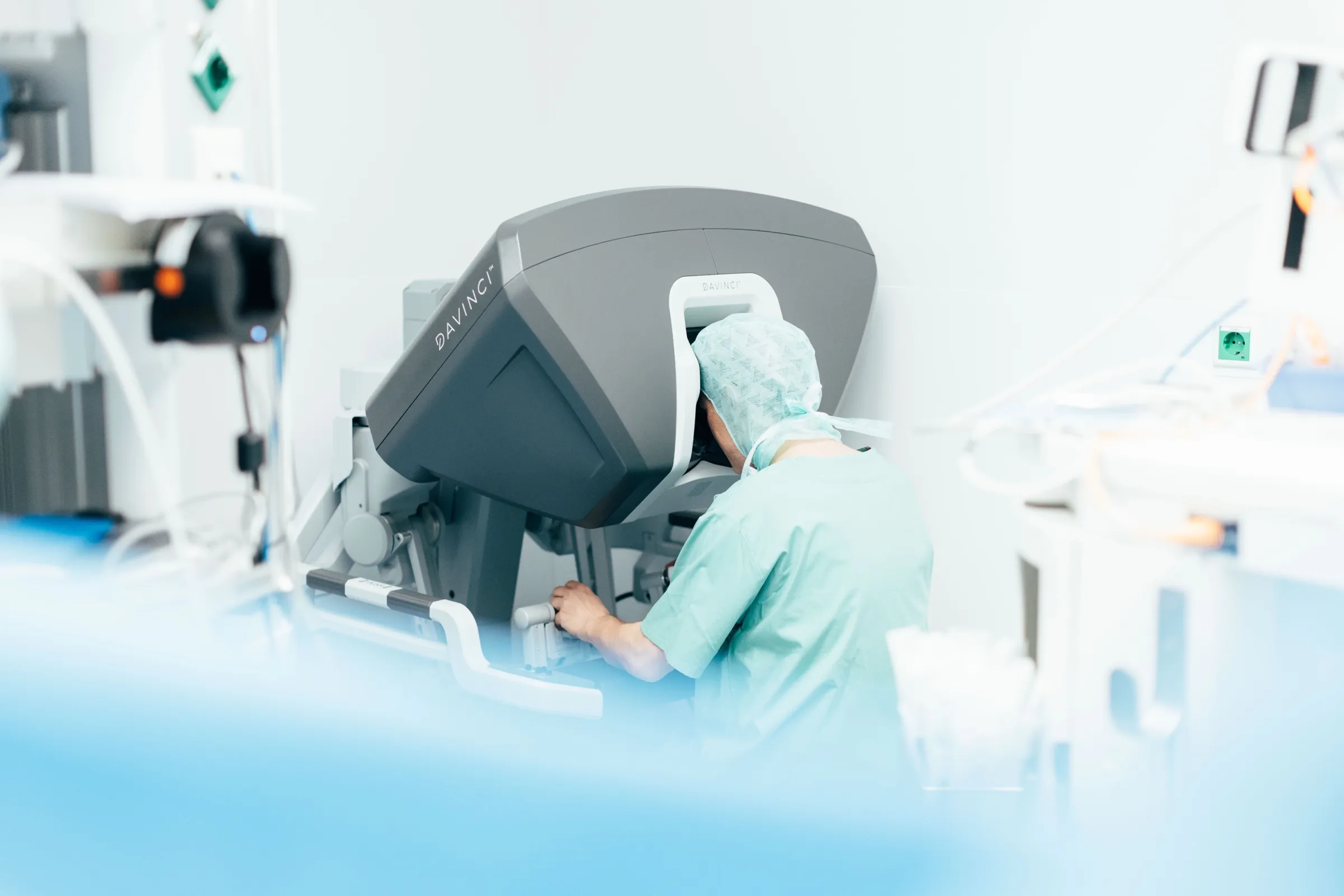
This is where the operation happens — eyes in the display, hands on the grips.
Contact
Second opinion and appointments
You have received a diagnosis and are unsure what comes next? Talk to us about the options. Please bring previous findings and imaging with you if you can.
Consultation hours
- Wednesday · 14:00
- Thursday · 08:30–16:00
PD Dr. med. Sami-Ramzi Leyh-Bannurah. Appointments are arranged by the urology secretariat.