Prostate · benign
Benign prostate enlargement
When medication is no longer enough, there are two good routes — and we offer both.
Benign means benign
Benign prostate enlargement is not cancer and does not become cancer. It arises in the inner part of the gland, which grows over the years and narrows the urethra. Prostate cancer typically arises in the outer part — they are two different diseases that can only coincidentally occur side by side.
This is the most common worry in our clinic, and it can usually be settled in a few sentences. A raised PSA level can come from the size of the gland alone. Whether anything needs further work-up is something we decide with you — not the value by itself.
Normal: the gland sits slimly around the urethra and the channel is open.
Enlarged: the inner gland presses on the urethra. The bladder wall thickens because the muscle works against the resistance.
Schematic illustrations — not images of a patient.
How you notice it
The stream gets weaker
It takes longer for the urine to come, the stream is thinner than it used to be, and it dribbles at the end.
You have to go more often
More often during the day than before — and getting up several times at night. The interrupted sleep is often more of a burden than the urination itself.
The bladder does not empty
The feeling that something is left behind. If residual urine remains permanently, infections, bladder stones and, in the long run, strain on the kidneys threaten.
When an operation comes into question
As long as the symptoms are bearable and the bladder empties, waiting is a legitimate path. Medication can improve the stream and shrink the gland. Only when that is no longer enough is surgery considered.
It becomes clearer when complications appear: when you suddenly cannot pass urine at all and a catheter has to be placed, when bladder stones form, when urinary tract infections keep returning, or when so much residual urine remains that the kidneys suffer. Then the operation is no longer a question of comfort.
Two routes, both in house
Both procedures relieve the obstruction and improve symptoms and urinary stream equally.
ThuLEP
Thulium laser enucleation · through the urethra
- Access
- no external incision
- Distinctive point
- no scars, shorter stay, shorter catheter time
The first route for most patients. The procedure is largely independent of the size of the gland: through the urethra, the enlarged inner tissue is peeled out of the capsule with the thulium laser, then morcellated in the bladder and removed.
RASP
Robot-assisted simple prostatectomy · through small ports
- Access
- 3 to 4 ports of about 8 mm each
- Distinctive point
- tissue removed in one piece, bladder treatable in the same session
The route for a very large gland, for accompanying findings in the bladder, and after a failed procedure through the urethra. Here too, only the enlarged inner part is removed — the outer shell of the prostate stays.
It is not the technique that decides. Both procedures are equivalent in their effectiveness. What suits you follows from the size of the gland, from what the bladder additionally shows, and from what matters to you. We will tell you openly if the procedure without the robot is the better one for you.
When we advise the robot-assisted enucleation
A very large gland
The larger the adenoma, the more the robotic approach plays to its strength: the tissue is enucleated in one piece, and morcellation in the bladder is not needed.
Bladder stones or diverticula
If stones or outpouchings of the bladder wall are present as well, they can be treated in the same session. A second operation is avoided.
After an earlier procedure
If a treatment through the urethra has not brought the desired result, robot-assisted enucleation is an established route.
Tissue in one piece
The adenoma is removed undivided and can therefore be fully assessed histologically — which matters when the PSA level is raised or a suspicion of cancer is in the room.
Eight millimetres
That is how small the port is through which the robot-assisted enucleation is performed. The tip of the instrument is more mobile than a wrist — which is why even a very large gland can be cleanly freed from its capsule.
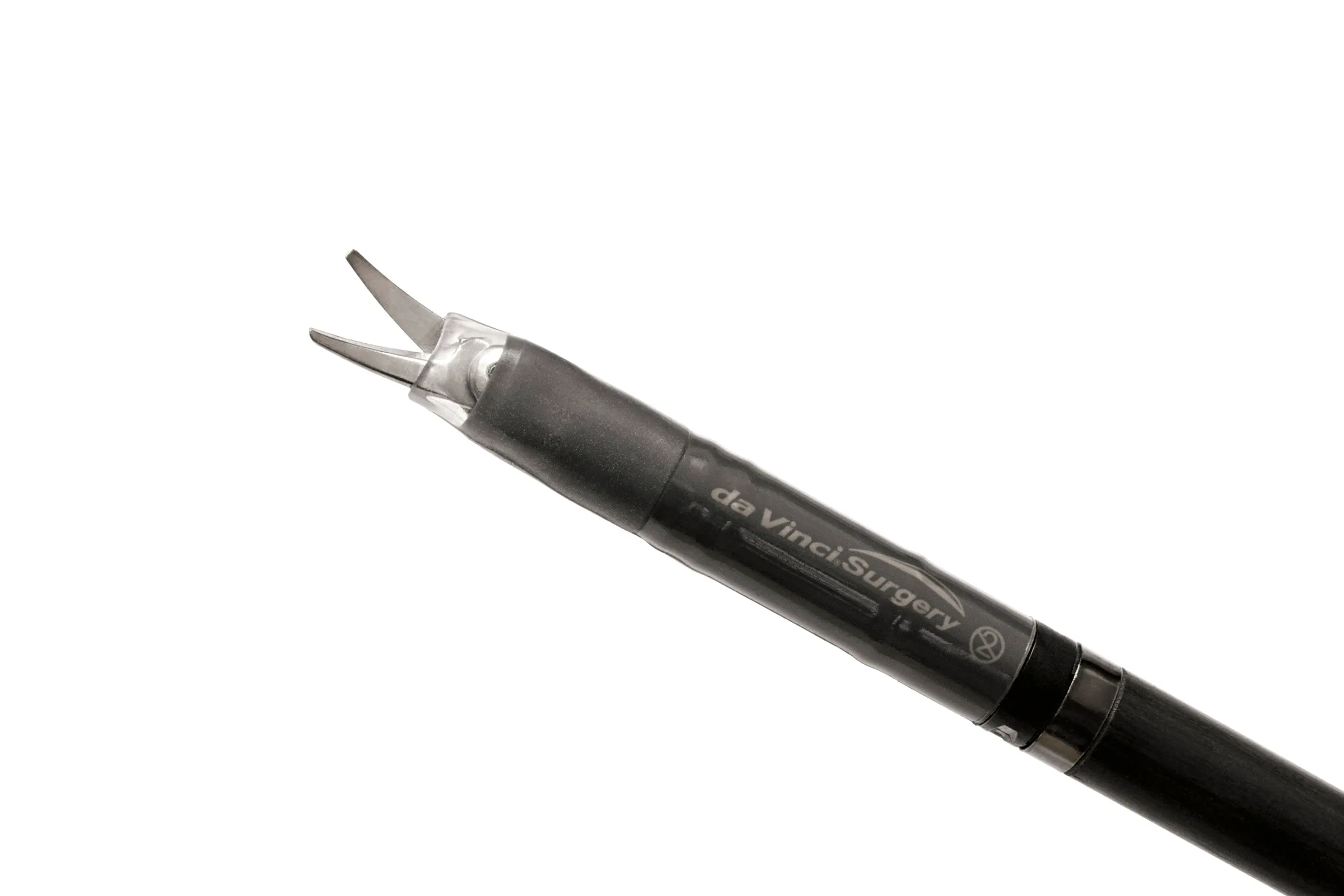
Instrument tip to scale: it is introduced through a port of about eight millimetres.
© 2026 Intuitive Surgical Operations, Inc.
Second opinion
Unsure which procedure suits you? We settle that in a conversation.
How it proceeds
Before
Ultrasound, measurement of residual urine, measurement of the urinary stream, and a questionnaire on the severity of the symptoms. Blood-thinning medication is discussed in good time — please do not stop anything on your own.
The operation
Under anaesthesia. The enlarged inner part of the prostate is removed; the outer shell and with it the sphincter stay. Afterwards a urinary catheter stays in place for a while, used for irrigation.
Afterwards
The catheter is removed as soon as the urine is clear. In the first weeks, passing urine may still burn and the urge may be more frequent — that settles. Pause heavy lifting and cycling for the time being.
What changes for you
A stronger urinary stream, more complete emptying, less getting up at night: that is the aim of the procedure — with both techniques.
One point belongs here openly: after the enucleation, the ejaculate frequently no longer passes outwards but backwards into the bladder. The sensation of orgasm stays, and so does erectile function — but natural fertility is usually no longer given afterwards. If you wish to have children, tell us beforehand.
Sources
Sandhu JS, Bixler BR, Dahm P, et al. Management of Lower Urinary Tract Symptoms Attributed to Benign Prostatic Hyperplasia (BPH): AUA Guideline Amendment 2023. J Urol 2024;211(1):11–19.
Kowalewski KF, Hartung FO, von Hardenberg J, et al. Robot-assisted Simple Prostatectomy versus Endoscopic Enucleation of the Prostate: A Systematic Review and Meta-analysis of Comparative Trials. J Endourol 2022;36(8):1018–1028.
Pandolfo SD, Del Giudice F, Chung BI, et al. Robotic assisted simple prostatectomy versus other treatment modalities for large benign prostatic hyperplasia: a systematic review and meta-analysis of over 6500 cases. Prostate Cancer Prostatic Dis 2023;26(3):495–510.
Perri D, Pini G, Besana U, et al. Functional outcomes and safety profile of thulium:YAG laser enucleation (ThuLEP) versus robot-assisted simple prostatectomy (RASP) facing very large (≥ 150 ml) prostates. World J Urol 2025;44(1):29.
John H, Wagner C, Padevit C, Witt JH. From open simple to robotic-assisted simple prostatectomy (RASP) for large benign prostate hyperplasia: the time has come. World J Urol 2021;39(7):2329–2336.

Each arm carries one instrument and is controlled individually.
Contact
Getting urinary symptoms checked
Bring what you have — ultrasound findings, PSA values, the list of your medication. The rest we measure here.
Consultation hours
- Wednesday · 14:00
- Thursday · 08:30–16:00
PD Dr. med. Sami-Ramzi Leyh-Bannurah. Appointments are arranged by the urology secretariat.