Bladder · Reconstruction
Urinary diversion
When the bladder is removed, the urine needs a new path. There are several routes, and we make the decision together with you.
Every route belongs on the table
The guideline is unambiguous on this point: ileal conduit, continent cutaneous diversion and orthotopic neobladder are to be discussed with every patient unless something speaks against them. We keep to that.
Which route fits depends on the tumour, on kidney function, on comorbidities — and on how you live and what you feel able to manage. We state the medical limits clearly; within those limits, the decision is yours.
The options
Ileal conduit
not continent · the established standard
- Urine collects
- in a bag on the abdominal wall
- Emptying
- continuous, with bag changes
The most frequently chosen route. Technically the simplest, the least prone to problems and with the shortest operating time — particularly suitable when comorbidities exist or kidney function is impaired.
Orthotopic neobladder
continent · in the original place
- Urine collects
- in a replacement bladder formed from small bowel
- Emptying
- through the urethra, voluntarily
An option when the urethra is free of tumour, the sphincter works and kidney function is sufficient. Emptying has to be relearned: it is done with abdominal pressure and by the clock, not in response to an urge to void.
Indiana pouch
continent · modified Mainz I pouch
- Urine collects
- in an internal reservoir made of bowel
- Emptying
- several times a day via a thin catheter
The route when a neobladder is not possible but continence is desired. The reservoir is catheterised through a small, discreet stoma — no bag is worn.
For patients in a reduced general condition, or when bowel cannot be used, the cutaneous ureterostomy remains an option as the simplest form of diversion — without a bowel segment and thus without the risks that come with it.
Second opinion
Unsure which diversion suits you? That is exactly the conversation the consultation hours are there for.
Sources
Treatment of Non-Metastatic Muscle-Invasive Bladder Cancer: AUA/ASCO/SUO Guideline.
Lee RK, Abol-Enein H, Artibani W, et al. Urinary diversion after radical cystectomy for bladder cancer: options, patient selection, and outcomes. BJU Int 2014;113(1):11–23.
Kern SQ, Speir RW, Tong Y, et al. Longitudinal health related quality of life after radical cystectomy: comparison of ileal conduit, Indiana pouch, and orthotopic neobladder. Urology 2021;152:184–189.
Polm PD, Wyndaele MIA, de Kort LMO. Very long-term follow-up of Indiana Pouches proves durability. Neurourol Urodyn 2024;43(5):1090–1096.
Martini A, Falagario UG, Russo A, … Leyh-Bannurah SR, … Hosseini A; EAU Robotic Urology Section Scientific Working Group. Robot-assisted radical cystectomy with orthotopic neobladder reconstruction: techniques and functional outcomes in males. Eur Urol 2023;84(5):484–490.
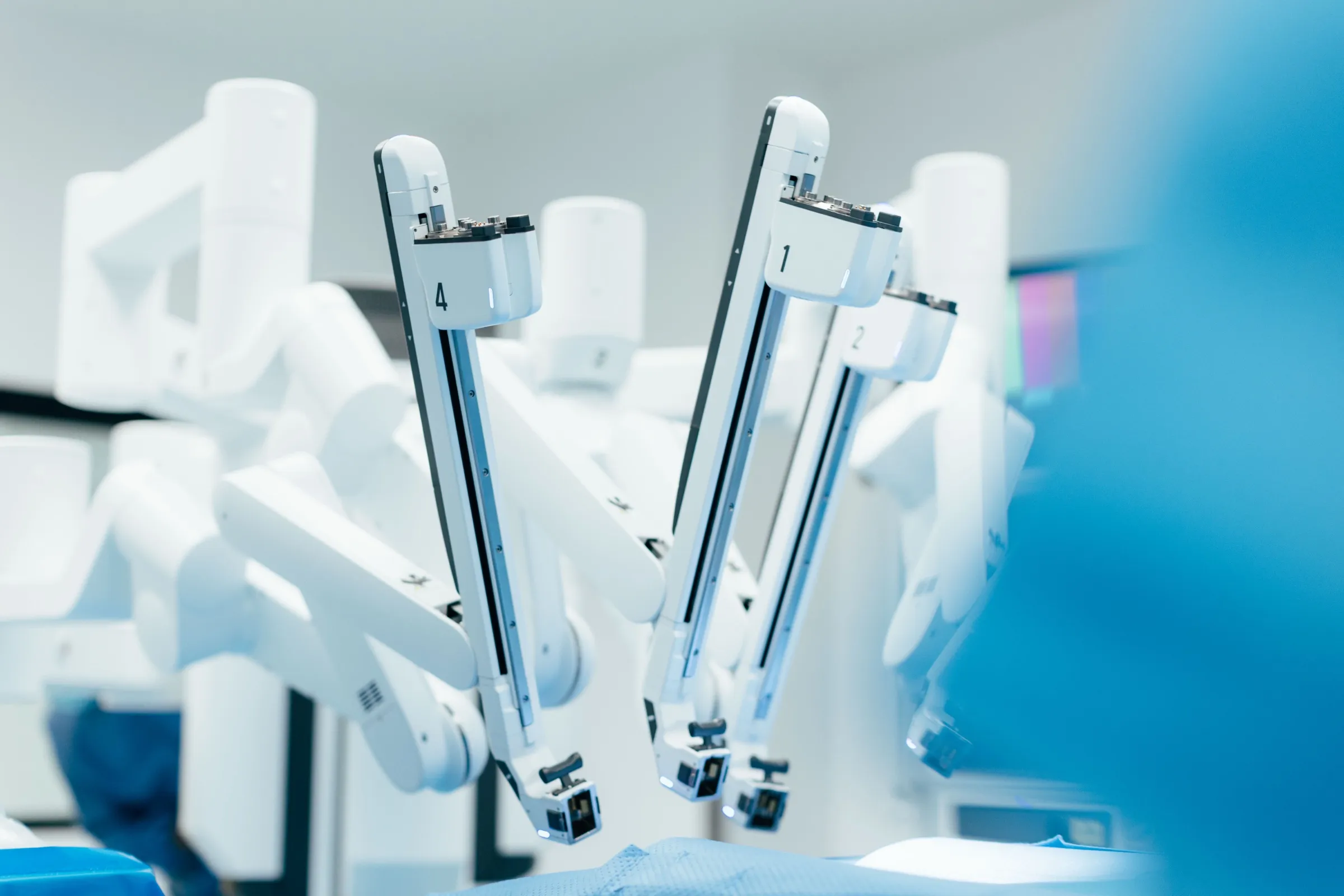
The new urinary diversion is built with the same instruments that removed the bladder — without an additional incision.
Contact
Discuss your urinary diversion
This decision is not one to make over the phone, and not one to make alone. Arrange a consultation — a second opinion is just as welcome.
Consultation hours
- Wednesday · 14:00
- Thursday · 08:30–16:00
PD Dr. med. Sami-Ramzi Leyh-Bannurah. Appointments are arranged by the urology secretariat.